Sanitation, a Shared Responsibility
19 September 2019
Recently, I watched a street quiz on television, a gentleman was caught on camera dropping a rubber on the floor when he was approached he said littering in Ghana is a norm and allowed because people have been paid to sweep the streets each morning.
This act of negligence and irresponsibility seems to be practiced by every Ghanaian. All though we take it for granted, poor sanitation has become a deficiency that is consuming all our resources and exerting more pressure on the government.
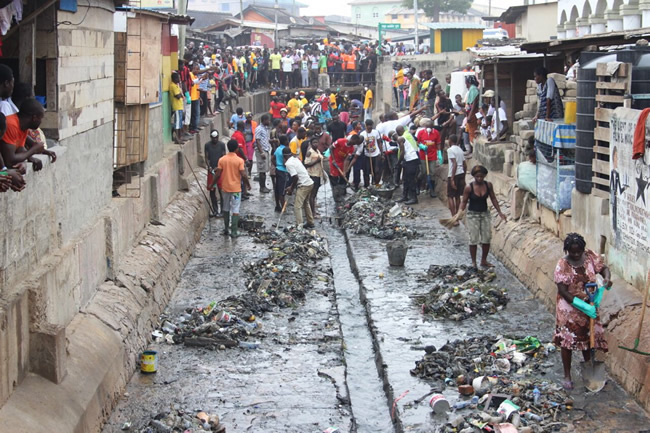
Ghana is now engulfed in filth. Every street and gutter are filled with sewage and dirt. People pass by these filth each day and show no concern. When others also dispose refuse improperly they are not confronted by others almost every one sees littering as a norm. Others on the hand do well to sweep but fail to collect the refuse. They leave the refuse and the wind disperses it into the streets and gutters getting them choked and spreading various epidemic diseases- cholera and the likes.
The effects of poor sanitation has been spelt out many times- announced by the media, taught in schools, taught in communities and almost everywhere in the country. Accra which is seen to host the greatest amount of filth has at least 70% of the people engaged in the wrong way of disposing of refuse and human excreta.
What then should be done? The countless floods that took lives seems not to change the attitude of most people. Do Ghanaians by chance want a great just like in the days of Noah before we change? Measures by government and other private institutions and individuals to solve this national menace have not yielded the desired results. Millions of cedi are spent annually hoping to solve it.
The government of Ghana as part of its responsibility to ensure that cities and towns are rid of filth has initiated a national sanitation day slated for November 1, every year. This is now a policy that the first Saturday of every month be observed as a National Sanitation day across the country. Every Ghanaian must observe this day wherever they are and volunteer to help clean their communities.
But how many Ghanaians recognize the importance of this policy. Most Ghanaians do not recall every first Saturday being a sanitation day and others who even do are mostly not interested in the clean-up exercise and thus reluctant to participate.
For this national menace to be cured its starts with the change of mind. Ghanaians must change their attitude and erase the idea of littering being a norm and rather see it as a threat to societal and national development. Sanitation is a shared responsibility and an individual responsibility. Ghanaians must keep their societies clean to help solve the menace which has now turned into the feature of society.
The Accra Metropolitan Assembly (A.M.A) is doing well to keep Accra clean by reminding Ghanaians on practicing good sanitation through the media and other outlets. As Ghanaians we must avoid dumping refuse improperly and defecating in the open and now one issue that seemed to be the greatest challenge-posting of bills on walls and on the streets but now the A.M.A. has given a temporal solution.
The A.M.A. recently launched a campaign dubbed ‘Accra for arts’ which would see the city use visual arts to project images of who we are in Accra and what we can offer the world. This initiative has kept the walls of Accra neat and quite attractive.
The government is doing its part to solve this sanitation menace. It is in our best interest as a people to team up and fight this menace. It is time we all practiced good sanitation and stopped talking only about it.
Sanitation is a shared responsibility. Let’s all get involved.
#societalhealing
#positiveghana
Reflections
Bishop Asare
21 September 2019
Beautiful piece....and very insightful....
aggieberks
13 November 2019
https://aggiebekoe.wordpress.com/2019/11/13/poverty-is-not-a-choice-time-to-return/
Smoke Reader
23 August 2026
A thoughtful smoke-test comment.
Smoke Reader
24 August 2026
A thoughtful smoke-test comment.
Leave a reflection
Comments are moderated. Yours will appear after review.